Christmas seems to last forever, then New Year's Eve, New Year's Day and now, at long last, we are back to normality. A brief reminder of December's events must include the well-attended brass band concert in the church, mentioned in my previous blog, when the Pleasley Colliery Band put us in festive mood with their choice of music; the Women's Institute held a very enjoyable Christmas Dinner in the Cross Keys. The church Service of Lessons and Carols was enhanced by the presence of a well-practised choir with members drawn from Oxton, Calverton and Epperstone.
Now the shortest day is well past. When the weather is reasonable we can spend an extra half hour in the afternoon on outdoor jobs. On one of these jobs I disturbed a newt. These tiny creatures resemble lizards and were once frequently found in the garden and greenhouse. Perhaps their numbers have diminished or perhaps, as an adult, I am simply further away from the ground! Whatever the reason, I was delighted to find it, also a small frog, whose numbers have certainly not diminished. I am always very reluctant to use herbicides and insecticides, finding that the balance of nature usually sorts things out, but I must admit that occasionally the weeds get out of hand - the saying "seven years seeds, seven years weeds" comes to mind!
Now is a good time to identify a number of birds, as they are easy to see in the leafless trees. The robin is always the first to tune up but there are many others already getting their brighter colours and thinking about pairing up in readiness for the nesting season. I have a new birdfeeder, a squirrel buster, that prevents squirrels from stealing the peanuts. Unfortunately the nuts in my last supply are quite large and do not fall readily into the feed ports so it could also be called a bird buster!
Several years ago a very large field owned by a local estate was made into two fields by the planting of a hedge. That hedge, although now very overgrown, is currently being turned into a stockproof and wildlife friendly hedge by the expert attention of a professional hedger. The work is very labour-intensive, and therefore costly but what a joy it will be to see the finished article.
Sunday, 6 January 2019
Wednesday, 1 August 2018
An Untypical Summer.
Farm News
...and so it goes on. The first rain we had here, after a dry June, was on July 20th and that was a barely measurable one point two millimetres. Farmers were having to combine the rape at night in order to get it in nearer to the nine per cent moisture required by the crushers in order to extract the oil. During the day it was too dry at six per cent as it is not possible to extract the oil when the moisture content is so low. The next job, once the rape was cleared, was one of the least popular jobs, that of muck spreading. The manure must be worked into the ground within twenty-four hours, but with the ground so dry incorporation is not so effective and the all-pervading smell lasts a little longer: one of the downsides of country living.
The wheat in First Hagg Lane Close has been combined and the straw cleared. Due to a combinations of circumstances the straw was very short this year. Varieties have been bred with shorter straw in an attempt to reduce lodging (going flat) as happens when heavy rain, or even worse, hail, comes when the crop is ripening. A straw shortener can also be used: an unnecessary cost this year, but how do you know in advance what the weather will be? The weather affects the yield. The yield affects the price. Do you sell some forward (before harvest) when you consider the price is right: the risk is the price and the quantity There are so many choices to be made and then there is still an element of luck!
Nature Notes
Going out later than usual to shut the henhouse I was pleased to see a number of bats swooping over the yard. Having several of the original buildings there are plenty of places for them to hang out in during the day. The date on the threshing barn is 1849 and we have a field record book where the first recorded entry is dated 1855. Several of the crops recorded are no longer grown, certainly not on this farm.
There is no shortage of nectar this year as plants in the herb garden have thrived in the sunshine. Honey bees, hover flies and several species of bumble bee, are all over the marjoram; with over 250 species of bumble bee I cannot pretend to have seen them all. They are also enjoying the teasel, another good nectar source.
The Social Side
A quick change of plan was necessary when it was discovered that the date chosen for A Quintessential English Tea, intended to raise funds for Epperstone church, clashed with Wimbledon finals and the football World Cup Final. Disaster was averted by a last minute change to the following weekend. Fortunately the weather continued perfect, ticket sales were good, the event was thoroughly enjoyable and a financial success, raising around £500 for much-needed funds.
Saturday, 7 July 2018
Summer - Continental Style.
Farm News
June was a strange month. After weeks of seemingly unrelenting sunshine, and no rain, at least in this area, our cereal crops are beginning to show signs of distress. In a wet winter the plants do not need to put down long roots to find water, with the result that now, with the upper layers of soil hard and dry, they are suffering. Our land is mainly keuper marle (clay) so holds moisture longer than the sandland nearby where cereals are already turning white and dying off. There is no doubt that yields will be lighter everywhere this year. Martins Hill and The Eastwood, drilled with rye in the autumn, were cut early in an attempt to get the blackgrass, with which it was infested, before the blackgrass shed seed. The result was a very low yield across thirty-eight acres (15 hectares), but hopefully the strategy will have reduced the blackgrass which is a huge problem at the moment. Oilseed rape is the next crop to harvest. It is quite short this year and has not gone flat, as happens when there are summer storms.
Wildlife
The spotted woodpecker which feeds on the peanuts, watched by it's young perched safely nearby, has now been replaced by the younger bird. They have such pretty colouring it is a pleasure to see them. Another welcome sight is the goldfinch family. I could not understand why the goldfinches were ignoring the niger seed when previously they had flocked to it. Enquiries revealed that niger seed deteriorates over time and mine had been in stock too long. A quick purchase of fresh seed has resulted in a rapid return of the goldfinches: point proved. Red kite, buzzard and kestrel are frequently seen over the farm, and especially when we were mowing for hay. Skylarks sing above The Hoe, where they always nest. Their song is beautiful as they fly to an incredible height. A magpie, possibly looking for water in the yard, was mobbed by the swallows and driven off in no uncertain terms. Magpies are well known for taking baby birds from the nest. I do not think they would find the swallows nests under the stable roofs but the swallows were taking no chances. Another visitor to the yard was a leveret (young hare) which, curiosity satisfied, ran off at speed when it saw me, the dog and the cat! An unusual daytime visitor was a young hedgehog, rooting through the bark chippings under the damson tree. Finally, a barn owl flies regularly across the garden, barn owls are seen in the lane and I hear the little owl in the evening, although it is equally active during the day.
Local News
Forget jam and Jerusalem. The June meeting of the Women's Institute was held in the beautiful garden of the Programme Secretary where members enjoyed a glass (or two) of prosecco or a Pimms, had a wander round the garden and looked for a number of everyday objects, previously hidden, which certainly had no place in a garden. The Book Festival in Lowdham could not possibly be overlooked. The village was made colourful with bunting, and knitted rosettes. Even the bollards. outside the Co-Op were dressed in knitted costumes
Thursday, 7 June 2018
Don't Count Your Chickens....
Although I generally follow the advice in the title and don't count my chickens before they are hatched I think I can safely predict an excellent crop of figs this year. The fig tree evidently enjoyed the early wet weather and now, in its sheltered corner, already the fruit is plentiful and unusually large for June. It should ripen from mid-August on and continue into September. Last year I put some into the deep-freezer at the end of the month then used them as a cooked fruit during the winter.
Seasonal farm operations are up-to-date although the frequent strong winds have made it difficult to apply insecticides, fungicides and herbicides when the relevant crops are at the optimum condition for achieving maximum effect. These products all add to the cost of production so it is in our interest to keep their use to a minimum and only to use them when necessary. Having said that, the rye which we drilled last autumn, as it is said to reduce the appearance of blackgrass, is still on the short side and therefore not effective at smothering out the blackgrass. As every growing thing seems to be twice its usual height this year perhaps it will catch up before it is cut later this month. We can only hope.
We saw a mallard duck leading her brood of six ducklings from the pond in the Stackyard Close onto the pond by the orchard. They are down to two, now but I saw her chasing off a moorhen. They are killers of ducklings so perhaps she was not always successful. She is a conscientious mother; I saw her sending a cock pheasant on his way. I am sure he had no bad intentions but she was taking no chances - very brave, I thought. We were fortunate to see a barn owl glide across the garden the other evening. It is always an impressive sight and we were prompted to say, as we always do, that we must put up a nest box on the farm then wait to see if it is adopted. Barn owls need quite a large hunting area, so there may be no room for another pair so close.
June is the season for fund-raising events. Many villages in the area hold Garden Festivals, Afternoon Teas, Teddy Bears Picnics, Open Gardens and of course, there is the now well-established Lowdham Book Festival which takes place from June 19th - 30th. This covers much more than books, and offers a programme of events appealing to a wide range of interests.
Monday, 7 May 2018
Oh, what a Beautiful Morning.
Oh, what a beautiful day! After waking to so many wet days it is a real joy to see the sun. Although I do not keep records I do not remember ever seeing so much rain in the first quarter of the year. It certainly made it difficult to start spring work on the farm as the ground became supersaturated and could not support the tractors and machinery. We held back as long as possible to avoid compressing the soil and making wheelings which then hold the water and cause problems with subsequent cultivations. In addition low temperatures made everything slow to start growing. Now the ground is warming up. The difference that the temperature makes is plain to see. Hedges are greening up almost overnight, as is the grass; fruit trees and ornamentals are thick with blossom; hawthorn trees and hedges will soon be a picture. I have not yet discovered if the saying "ne'er cast a clout till may be out" refers to may blossom (another name for hawthorn) or to the month of May. If you know the answer to this one perhaps you would be kind enough to tell me.
Locally we have a huge new Garden Centre to visit. Beside the "old" A46, not far from Bingham, in common with many garden centres it sells a wide range of merchandise in addition to plants and garden goods and has a restaurant/tearoom where the non-garden minded can while away the time.
Now is a good time to do some bird-spotting. While the trees are not in full leaf it is not difficult to locate the bird whose song I am trying to identify. Many are nesting now so it is not unusual to see a blackbird with its beak full of "baby food". They do work hard. Oddly, three male blackbirds seem to be determined to nest inside the farm buildings. They are constantly sparring with each other for supremacy. There are more collared turtle doves here this year; the chaffinches are back from their partial migration and several robins have established their territories. I was pleased to see moorhens back on the pond. The mallard ducks have been spoilt for choice this year, with water where no water should be. Brave swallows arrived on April 13th; they like to sit on the weathercock, keeping up a non-stop twittering when they are not swooping to and fro over the buildings in their search for insects.
Monday, 2 April 2018
A Little Bit of History.
There was recently some discussion concerning a tree in the churchyard. Felled many years ago, due to it's unsafe condition, many residents are convinced that it was a yew. There are few who remember that it was, in fact, a splendid specimen of a Cedar of Lebanon. The proof came to light when a current resident, whose family had lived in Epperstone for many years, was going through a scrapbook compiled by her late mother and found a newspaper cutting with a picture of the tree, undeniably a cedar, with an article recounting how the felling had been necessary. It is unfortunate that the local History Society no longer exists. Today's current events quickly become history but are easily lost in an age when so much is consigned to computers, and scrapbooks are a thing of the past.
Anyone who had been hoping that the spring equinox would bring a change in the weather will have been disappointed. In fact we saw widespread snow again, with drifting in a strong east wind. My hens managed to keep the ice in their water trough broken during the day but it froze each night, so that they were unable to drink at first light. It meant an early start to the day to thaw out the ice and provide warm water. Incidentally, I was inspired to look up the meaning of equinox. My dictionary tells me that it is the time when the sun crosses the equator, making the night equal in length to the day. It occurs about March 21st and September 23rd. Shall I remember that, come September?
The hazards of rural life: the congregation at the Easter Sunday Service in Epperstone church was larger than usual. The reason? Wellington boots would have been needed to access neighbouring Gonalston church as the path was completely water-logged, causing the vicar to take the unusual step, possibly for the first time, of cancelling the service.
Attendance was also up at the Annual General Meeting of the Women's Institute. Meetings are held on the second Tuesday of the month and guests are always welcome. The programme of speakers and activities is varied and interesting so it is no surprise that, in three year's time the local branch will be celebrating one hundred years in existence.
Bollywood Dancing; the W.I. under instruction.
A last word on life outdoors. Songbirds are pairing up for the breeding season. The colours of the male birds are noticeably brighter and their songs more insistent as they seek to attract the females. Blackbirds chase each other around the lawn, robins claim their territories, a thrush sings lustily from the top of the cedar tree and the pheasant struts around the orchard in a very possessive fashion. Overhead buzzards, once a rare sight round here, are now to be seen and heard, wheeling and mewing over the paddock.
Saturday, 10 March 2018
February Fill Dyke
Well, what a month we have had. The wet weather of February is but a distant memory, blotted out by the snow and the incredibly cold east wind we experienced earlier this month. On the farm it was a battle to get water to the horses; the hens water supply froze nightly and had to be thawed out each morning; not a pleasant task. As an egg contains a high percentage of water I anticipated a drop in egg production but the hens, clearly finding they were better off inside than out, managed to keep on laying. The extreme cold then gave way to a quick thaw which inevitably, in spite of having taken preventative measures against the cold, lead to burst water pipes. However, we must be thankful that, for now at least, temperatures are back to normal for the time of year and we hope that we shall not see a return of the snow which is still affecting other parts of the country.
As the breeding season approaches many birds are singing lustily. Perhaps they are making up for lost time. The feeders need replenishing daily. A group of long-tailed tits visits regularly, there is an increase in the number of chaffinches and a pair of bullfinches has also been seen. It would be good if their numbers increased. The barn owls which nest locally must have had difficulty finding food as they rely, for a large part, on small mammals, such as voles, which would have been hidden under the snow. A heron was seen inspecting the pond; it flew off unsatisfied, the fish being well down in winter. March is the month for Toadwatch, of course, when Beanford Lane is closed to protect the toads crossing the road to spawn in the lakes. Additionally there will be toad signs in Blind Lane, in Oxton, warning drivers to take care as toads will be crossing. Local residents, who will be patrolling as usual, will be happy for any support given.
The Bookcase, in Lowdham, has published the First Friday programme of talks, all of which involve subjects of local interest. The talks take place in the Methodist Chapel, in Lowdham on the first Friday of the month. If all are of the calibre of the Pitman's Story they are definitely not to be missed. Fans of Gilbert and Sullivan operas can also enjoy the cabaret and film night in Lowdham Village Hall on March 30th. Anyone who enjoys a social evening plus talks on a range of subjects of rural interest may be interested in the Country Link organisation. The next talk, to take place at The Gleaners, in Calverton, will be about the British Equestrian Federation. Non-members, for whom there is a small charge, are, of course, welcome.
Sunday, 4 February 2018
February Brings the Rain.....
More rain. Not much different from January, really. Are those who live in the country more conscious of the weather? It certainly dominates the conversation at the moment. I felt quite pleased to see it was the subject of an article published by a regular contributor to the parish magazine, The Dover Beck, and to see that I am not the only one to feel that January is a hard month to deal with. Admittedly we only had a dusting of snow in the south of the county but there have been some bitter winds.
The garden birds have made the most of the birdfeeder, which is filled daily. On several occasions we have hosted a group of long-tailed tits; a heron was spotted, inspecting the pond for fish, but flew off disappointed. A thrush has joined the chorus of birds tuning up for spring. He is easy to spot as he sits on the topmost branch of the Lebanon cedar on the lawn in front of the farmhouse. I hope it is a song thrush, not a mistle thrush as there are fewer of them but I need a few more clues before I can be certain. From time to time a horde of starlings also descends to feed. They nest in a small spinney of beech trees behind the farm. It shows on old maps as quite an extensive wood which probably accounts for the name of the farm being Eastwood.
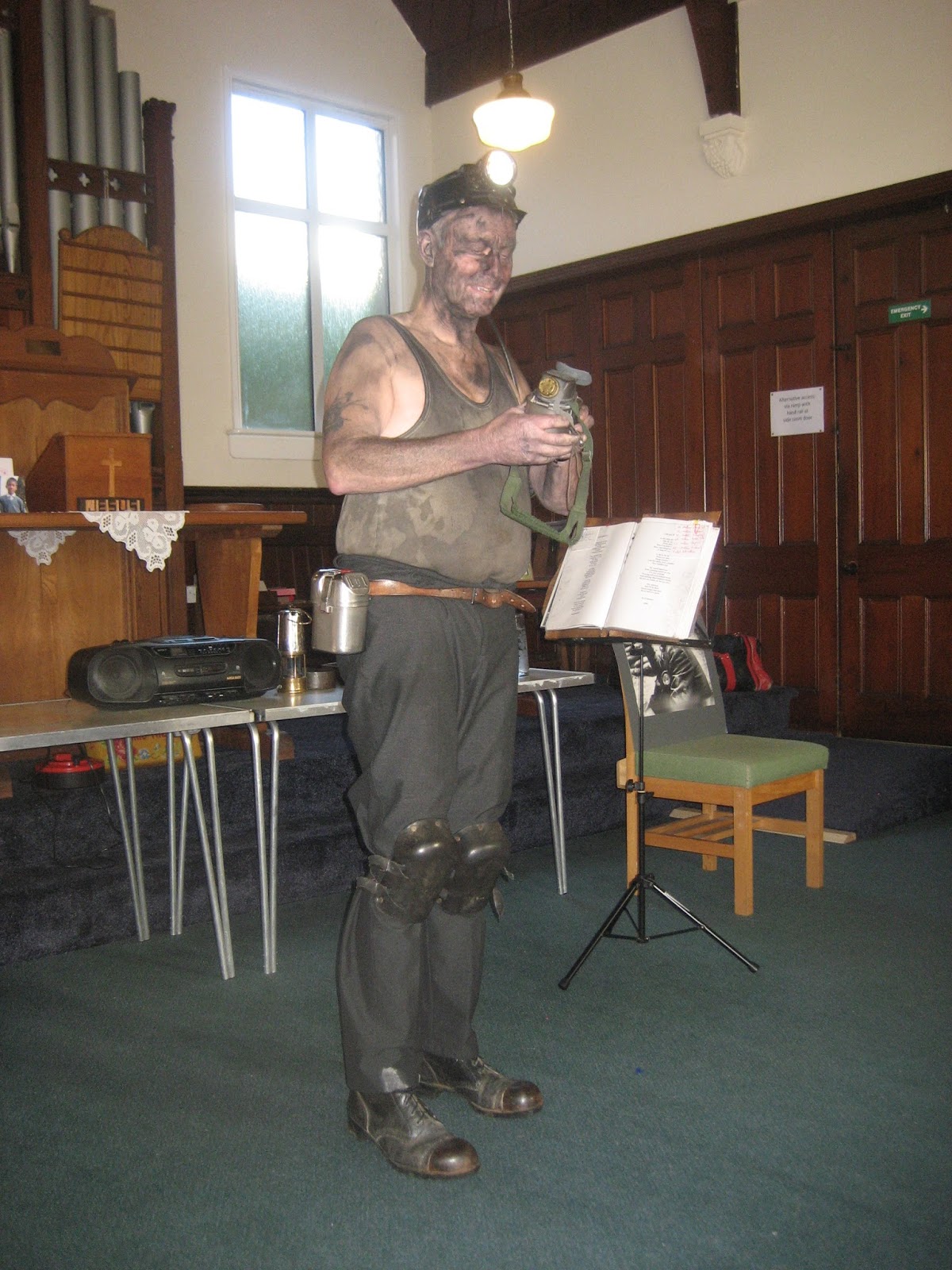
Lowdham Bookcase First Friday talks in the Methodist Chapel kicked off with
A Nottinghamshire Pitman's Story, a book commemorating the ending of an industry which was once a way of life. The author, David Coleman, a former pitman, held his audience spellbound with his many authentic stories, anecdotes and poems, the while dressed in full miner's working kit. It seems regrettable that an industry which employed so many men has no mining museum in Nottinghamshire. Steam railways have their volunteer enthusiasts; perhaps it is something that could be considered by those who feel that mining was a major industry in the county and a part of our heritage and should not be forgotten.
Life on the farm, at this time of year, is concentrated mainly on maintenance, tidying, apple and pear tree pruning (by the end of the month) in fact all the jobs which need tackling but for which there is rarely time in the spring or summer. Talking about the farm got us wondering about the meaning of the word "Hagg" as in the address, Hagg Lane. I once read that it was an old Norse word, meaning a ravine. I like that explanation as the lane, fifty years ago, really was deep and steep, with a high bank on either side. If anyone has an alternative suggestion do, please, pass it on to me. I would be really interested.
Sunday, 7 January 2018
Eastwood Farm : Whether the Weather be Cold...
Eastwood Farm : Whether the Weather be Cold...: Twelth Night has passed, and Christmas decorations are down. I...
Whether the Weather be Cold...
Twelth Night has passed, and Christmas decorations are down. It is time to get outside and do those winter jobs that I thought up in summer, but always forget to take into account the outside temperature and the possibility of rain. Fiery red skies at night have been a feature of this winter. I am not sure if they have proved to be a shepherd's delight, as the saying goes, but they have certainly delighted me. Recently, though, they are in "Red skies in the morning, shepherd's warning " mode, and not without reason. High wind and heavy rain has followed; a tree came down, obstructing the street through the village. Fortunately it happened at night, causing neither injury nor damage. It was, however, a timely reminder that, if the area on which a tree falls is used by the public, any damage caused is the liability of the owner of the land on which the tree is growing. This makes an annual inspection a wise decision.
The sheep have left us, having grazed their plot to an acceptable level. There were two , casualties, attributable in all probability to an out- of-control dog, but no means of identifying the culprit. It is fortunate that the toll was not higher.
The tawny owl has started to call again although the breeding season is not normally before March. It lives in a beech tree, quite close to the farmhouse, and startles me when I go to shut the henhouse at night; a necessary precaution against foxes. The robin also thinks that spring is not far away; they are one of the earliest in the year to start up again and also sing quite late into the evening. At this time of year the birds are clearly grateful for the food I put out. They have peanuts, suet balls, niger seed and mixed seed and the feeders are filled every day. The feed comes from a farmer near Spalding who grows much of the seed himself. He keeps extensive records of the weather, the birds on his farm and also supplies feeding equipment and nest boxes - a useful contact to have.
On a final note, as this is mainly about birds; a huge flight of geese went over last evening, in the echelon formation characteristic of the greylag goose. The sound they make as they fly and their slow, strong wingbeats, make them readily identifiable.
The last word.
"Whether the weather be cold, or whether the weather be hot,
We'll weather the weather whatever the weather
Whether we like it or not"
Thursday, 16 November 2017
The Fall - Well Named
Mid November; temperatures plummeted and felt lower still in the keen wind. It seems, however, to have been a temporary blip and we are now back to an unseasonable but comfortable fourteen degrees or so. The countryside is in winter mode. Most of the trees have lost their leaves now, brought down by wind and rain. Soon I shall be able to take leaf sweeping off the daily chores list. It has been a beautiful autumn for colour, due, I believe, to the amount of rain in September which allowed the trees to hold their leaves for longer.
Those who attended Epperstone's Laying of the Wreath ceremony on Remembrance Day were grateful for the sun which shone. The occasion, marked this year by the addition of the Last Post and the Reveille played on the bugle, seems to have particular relevance in a small village, as so many of the names which are read out are from families whose relatives still live in the area.
The Bookcase in Lowdham held its usual Christmas Shopping morning, a useful as well as social event, which included a demonstration of Christmas canapes (tasting obligatory)! How do they do it in such small premises? The First Friday talk, entitled "The Wisdom of the Mountains" concerned the Buddhism of Tibet and the Himalayas and, though an unusual subject, was very well attended. Also well attended was the Women's Institute 97th birthday party. No sign of jam and Jerusalem but the usual splendid buffet, followed by a lesson in Bollywood dancing. The more adventurous members dressed in saris, expertly draped by the demonstrator, followed her movements and gestures closely as she explained their meaning; an unusual and entertaining end to the evening. It cannot be said that we are limited in our range of interests.
Not a lot to report on farming activities. It has not been an easy year, as was confirmed by several farmers attending a recent meeting of the Nottinghamshire Farm and Country Tourism Group. Weather and ground conditions as winter approached made delayed drilling an anxious time. This was followed by two weeks of entirely suitable weather which, had we been sure of in advance, would have substantially lowered stress levels. That's farming for you.
Tuesday, 16 February 2016
January Brings the Snow.....
....but it didn't, so shall we get it this month? Here in the East Midlands we have only woken once to a light sprinkling of the white stuff and it did not last long. As I write I am looking at sunshine and frosty ground outside; I have a feeling we have not seen the back of winter yet.
There is a lot of blackthorn in the hedges locally and that is flowering already; birds are pairing up in readiness for breeding. This week, from February 14th - 21st is National Nest Box Week. Modern building methods and a "tidy" countryside have caused a loss of habitat for many species of bird. Consider putting up a nesting box, even if you only have a small garden. There are many different types and sizes available; you will see it being checked out by prospective occupants and in due course can have the pleasure of watching nest-building and subsequent brood-rearing activities.
Heavy rainfall earlier in the month left water standing in fields, making ponds where no ponds should be. Wild ducks were quick to spot them and when I went into the pony paddock I was amused to see five mallard making the most of this new feature.
A recent, and not entirely welcome, visitor to the bird feeders, has been the sparrowhawk He comes at around noon, when the bluetits and other small birds are feeding. Sitting in the damson tree he is well-disguised and can dart out and scoop up any bird who is not aware of his presence. The birds learn quickly, though and find safety amongst the tangle of branches where the sparrowhawk cannot make a quick grab. His strategy has been to dive at them repeatedly until they tire and are then not quick enough to avoid him. It is fascinating to watch and although I would prefer not to see the capture, it is nature at work and not for me to interfere.
The evenings still seem quite long so it was no hardship to attend a meeting of the Women's Institute this month. Jane Streeter, proprietor of The Bookcase, in Lowdham, gave an interesting talk entitled, appropriately, "More Than a Book Shop" From a very small beginning the shop has evolved to develop a wide range of activities, thereby extending it's appeal to a much greater number of local supporters, not simply to readers. The best known is probably the Festival in June but events throughout the year include film shows in the Village Hall (complete with popcorn), First Friday talks in the Methodist Chapel, by writers, collectors and others with special interests. I am looking forward to the first weekend in March when a number of films based on books are to be shown. It will be difficult to chose which ones to see but if you are staying at The Mews there is certain to be something of interest to you - a perfect chance to widen your horizons.
.
Monday, 1 February 2016
Winter
So the winter drags on. Mid-January saw a dramatic fall in temperature and we had our first snowfall. In twenty-four hours it had nearly gone and we waited to see if the old saying that it takes another snowfall to take the first away was fact or fiction. Well, I can report that, in 2016 at least, it was fiction because two days later there was no trace of snow and once again the temperature had risen. As I have said before, in Britain we don't have climate, we have weather.
My small free-range flock of laying hens is wintering well; the rain does not seem to bother them although it makes for unpleasantly muddy conditions underfoot. So far only two are moulting; that is also unusual. It makes them fair game for the others who take every opportunity to peck them - a clear demonstration of the meaning of the phrase "the pecking order".
It will be interesting to see the result of the Farmland Bird Count which is scheduled to take place between February 6th - 14th. With buzzards, foxes and badgers on the increase I expect to see a reduction in the numbers of ground-nesting birds. It is important to leave cover to protect them wherever possible. I find it hard to believe that House Sparrows, are on the endangered list, as there are plenty to be seen here. They live in quite large family groups, are incredibly shy, and fly into the nearest hedge at the slightest disturbance. Another attractive visitor is the Long-Tailed Tit, or rather, Tits, for they also live in families. They are a delight to watch and hear as they fly down onto the bird feeder for a welcome top up.
On the farm we continue the battle against blackgrass. It has appeared in yet another field. Where does it come from? Spraying at the right stage of development and in the right conditions is critical to success in eliminating, or at least reducing it, but so often the weather dictates and we cannot get onto the land without damaging the soil structure. It then becomes necessary to employ a contractor, who will have the best equipment for the job, but this will add to the cost; a difficult decision to make.
Monday, 18 January 2016
Epperstone and the Environment
I am going to have a little grumble. Hagg Lane is privately owned, gives access to several businesses and is also registered as a public footpath and bridlepath. When the verges recently had their bi-annual cut quantities of drinks cans, bottles, polystyrene food trays and sweet wrappers, much of which can be recycled and none of which rots down, were revealed. Wouldn't it be nice if the person or persons responsible for this mess read my blog and made a New Year resolution to take their rubbish home with them and dispose of it correctly? Wishfull thinking, perhaps, but don't you agree?
Being an arable farm all is quiet during the winter months; although it is not cold the ground is wet and would be damaged by the passage of heavy machinery. However, this is not unwelcome as it makes up for the long hours spent in cultivations, crop care and the harvest season. If proof was needed of the mild temperatures I spotted several clumps of primroses in full flower on the north-facing ditch banks in the Eastwood. Being north-facing these banks do not dry out so much in summer so provide ideal conditions for the survival of the primroses and the spread of their seed.
Pollarding of the willows on the west bank of the pond, long overdue but carried out earlier this month, has opened it up considerably and made it more attractive to the mallard duck who visit it annually. It was a pleasure to see three of them on the water when I went out early one morning. I am hopeful that a pair will nest there and rear ducklings There has been no sign of the moorhens lately but this is all to the good as they have a reputation for killing ducklings.
Social life in Epperstone continues; Wednesday coffee mornings in the church are popular and well attended. Newcomers to the village find it is a good way to meet and make new friends. Parish Councillors celebrated 2016 with an excellent dinner in the Cross Keys. The W.I. are looking forward to the next meeting when Jane Streeter will be giving a talk about her shop, The Bookcase, in Lowdham, which is, as she says, "more than a bookshop"; and so it goes on, with, hopefully, something for everyone.
Being an arable farm all is quiet during the winter months; although it is not cold the ground is wet and would be damaged by the passage of heavy machinery. However, this is not unwelcome as it makes up for the long hours spent in cultivations, crop care and the harvest season. If proof was needed of the mild temperatures I spotted several clumps of primroses in full flower on the north-facing ditch banks in the Eastwood. Being north-facing these banks do not dry out so much in summer so provide ideal conditions for the survival of the primroses and the spread of their seed.
Pollarding of the willows on the west bank of the pond, long overdue but carried out earlier this month, has opened it up considerably and made it more attractive to the mallard duck who visit it annually. It was a pleasure to see three of them on the water when I went out early one morning. I am hopeful that a pair will nest there and rear ducklings There has been no sign of the moorhens lately but this is all to the good as they have a reputation for killing ducklings.
Thursday, 31 December 2015
Warm, Wet and Windy.
Filling the bird feeders is a regular job at this time of year. I could set my clock by the time the birds feed, which is useful when I want to look out for any newcomers. House sparrows and many other small birds leave the farmland in winter and go for garden bird feeders where fat products are particularly valuable. I provide suet balls, which are less costly than peanuts and do not attract squirrels. Having said that it is entertaining to watch the squirrels running around in the leafless trees and jumping from branch to branch.
Saturday, 12 December 2015
Christmas is Coming.
A lot of rain recently has made outdoor activity rather unnattractive. Happily the programme of local events has provided a pleasant alternative. The Bookcase put on an unusual seasonal talk, starting with a potted history of the Christmas Tree, and its introduction to the festive scene in Britain. Not surprisingly, as it was a feature of German festivities, it appeared in the royal household, at the time of Queen Victoria. From there it was quickly adopted by the general public and has remained, ever since, an essential ingredient of our Christmas decorations. The remainder of the afternoon was given over to showing pictures of unusual baubles, mainly glass, but some in other fabrics, collected by the speaker, Peter Smith, over a period of years.
Initially most of these baubles were to be found in the USA but as their popularity and variety increased they became more readily available in this country. Techniques for their production developed.
With a collection of over 200 to choose from Christmas in the Smith household must be a daunting undertaking every year.
Writing about Christmas decorations reminds me that our holly trees, which were thick with berries a few weeks ago, have now shed most of them, making a carpet on the ground beneath. This happens nearly every year and I should really like to know why. It may be the few windy days we have had; it certainly is not lack of water. Oddly enough the birds do not seem interested in them. The blackbirds prefer the fallen apples and have now been joined by flocks of fieldfares. A sparrowhawk is to be seen regularly hovering over the long grass in the paddock before swooping down on some small mammal; what amazing eyesight they must have. Another welcome sighting has been the barn owl, flying low along the hedge in the same paddock. The tussocky.grass provides a good supply of voles which are a favourite source of food for the barn owl.
Monday, 23 November 2015
Jerusalem - Without the Jam.
Fish and chips was the order of the day (and you can't get more British than that) on the occasion of the Epperstone Womens Institute birthday party celebrating 95 years in existence. Entertainment was provided by The Stormy Weather Boys, who had everyone joining in lustily with the choruses of their sea shanties. The evening raised a welcome £300 for the charity, Maggies, the cancer support unit at Nottingham City Hospital and also, hopefully, attracted a few new members.
The social whirl continues with the Epperstone Ladies Luncheon to be held at the Cross Keys next month; but more of that later.
Rain and strong winds have been the feature of the weather during the past two weeks. Amazingly, little damage occurred on the farm though some of the willow trees round the pond are looking a bit the worse for wear. Not for nothing are they called Crack Willow. They are in desperate need of pollarding; this is something I shall have to look into with some urgency. The same wind has fetched the last remaining leaves off the trees, conveniently blowing them into heaps and thus making them much easier to collect. Nevertheless, I shall have to take care that some of the longer lying heaps are not hiding any hibernating mammals such as hedgehogs, of which, I am pleased to say, we have had many sightings during the summer. There has been a catastrophic decline in the hedgehog population, estimated at 1.5 million in 1995 and now reduced to probably under a million. If you want to know more about these creatures the website www.hedgehogstreet.org is full of interesting information and well worth a read.
Writing as a tourist, I found myself in Plymouth recently and was delighted to find that there is an excellently presented exhibition centred on the Pilgrim Fathers Their origens, of course, are centred on the village of Scrooby, in North Nottinghamshire so the exhibition made a good follow-up to what we already have in the county. If you want to brush up on the history of these brave people you can find much detail on www.pilgrimfathersorigens.org then make it the object of a day out.
Monday, 9 November 2015
A Warning.
It has been an amazing year for fruit, both cultivated and hedgerow. Those of you who enjoy a glass of sloe gin will find the fruits in plenty and can use the long, dark evenings to make a warming winter tipple. It is not necessary, as some would have it, to wait until the first frost before picking your sloes, nor is it beneficial to put them in the deep freezer unless you want to store them to be dealt with at a more convenient time. It should be remembered, however, that blackthorn, which produces the sloe, has very sharp thorns and a prick or a scratch from these can rapidly turn septic, so take care when picking the fruit.
Epperstone social life gathers momentum as the evenings get longer. A Wine Tasting event, organised by the Sports and Leisure Club, was sold to capacity and raised welcome funds for the Club. A large crowd enjoyed Bonfire Night and fireworks at the Cross Keys.
Members of the Womens Institute are looking forward to a party celebrating ninety-five years since the formation of the Branch; not a bad achievement.
Tuesday, 27 October 2015
Culture In The Country.
As the hours of daylight shorten there is an incentive to become a little more sociable. That is not difficult within the area. The Bookcase,
in Lowdham, launches a programme of events in November which includes, this year, a talk on beekeeping and all its aspects, an increasingly popular subject. There will also be the opportunity to meet Rachel Joyce, author of The Unlikely Pilgrimage of Harold Fry, who will be celebrating the publication of her latest book, The Snow Garden. Those who enjoyed War Horse will be able, once again, to spend an evening in Southwell Minster with master-storyteller and bestselling author, Michael Morpurgo.
Shorter days also affect the outdoor routine. My small flock of free-range hens goes to roost earlier so they are spending more hours shut in. This in turn means that the henhouse must be cleaned at shorter intervals. The alternative is to get up earlier to let them out at
daylight - not really a very attractive idea! I am sometimes asked if egg production drops in the winter, but the answer is that hybrid birds tend to lay all year round, though in slightly reduced numbers. It is the pure-bred, so-called rare breed birds, that lay very few eggs or stop laying until the spring.
The trees are beginning to lose their leaves; the colours have been really vivid this autumn. A good strong wind is needed to blow them into heaps which will mean less work when it comes to raking them up and moving them. If you can store them they make wonderful leaf mould to subsequently return to the garden. A word of warning - hedgehogs normally go into hibernation in October, though with the mild temperatures we have experienced lately it is possible that they are still around. Nevertheless be aware that a pile of leaves may be hiding one of these increasingly rare little creatures and any disturbance reduces their ability to survive the winter. Equally, if you are lighting an autumn bonfire check first that it has not been chosen as the winter home for local wildlife.
Thankfully our fields are all drilled up for the winter. It is always a worrying decision to make; shall we drill or shall we hold back a little longer? Too early and the crop risks being too advanced and at risk of disease or weather damage; too late and our heavy land may become too wet to support the passage of machinery. Well, now it is done and, believe it or not, we could do with some rain to get things going. No wonder people say that farmers are never satisfied.
Thursday, 15 October 2015
Goings On in Autumn
With the cereal harvest well and truly behind us the village has celebrated in customary fashion. Harvest supper, always a popular event, took place in the village hall. Villagers enjoy an excellent meal of boiled ham, vegetable bake and potatoes served with a very special plum sauce; vegetarians are catered for then it is head for the desert table where the choice is spectacular and limited only by the amount one can get on the plate. A very enjoyable social evening. This was followed on Sunday by the Harvest Festival Service in the beautifully decorated Holy Cross Church.
It has always been customary to take offerings of food to this Service for subsequent distribution to the less well-off and whilst fresh fruit and vegetables make an attractive display it is now deemed more practical to take items which can be stored and taken to the local food bank which the church supports.
Since writing about field mushrooms i have been on the lookout for blewits, a species of edible fungi much sought-after and, I believe, most frequently found in the Midlands. Certainly they are to be found for sale on local market stalls. However, they should be treated with caution when eaten for the first time as they can cause an allergic reaction in some people.
We are fortunate in having a bookshop in the neighbouring village whose proprietor puts on many events during the year. The Autumn/Winter programme has just appeared; it contains talks which will appeal to a wide range of interests. The talk on beekeeping is sure to be popular and that entertaining duo "Cook and Book" is back.
While there is no shortage of things to do and see in Nottinghamshire it is sometimes worth looking a little further, which is why Sunday found me visiting the village of Eyam, in Derbyshire. Incidentally,the pronunciation of the name is open to debate, being pronounced "Eem", one syllable rather than Ee-am, two syllables - rather like our local town, is it "Suthell"or "South-well? Be that as it may, it is best known as "the plague village" the story of which is well-documented and presented in the museum in the village with an excellent video, pictures and showcases. The museum has also mounted a new exhibition, running until 2018, entitled Eyam 1914-1918, and this too makes fascinating viewing.
.
Subscribe to:
Posts (Atom)